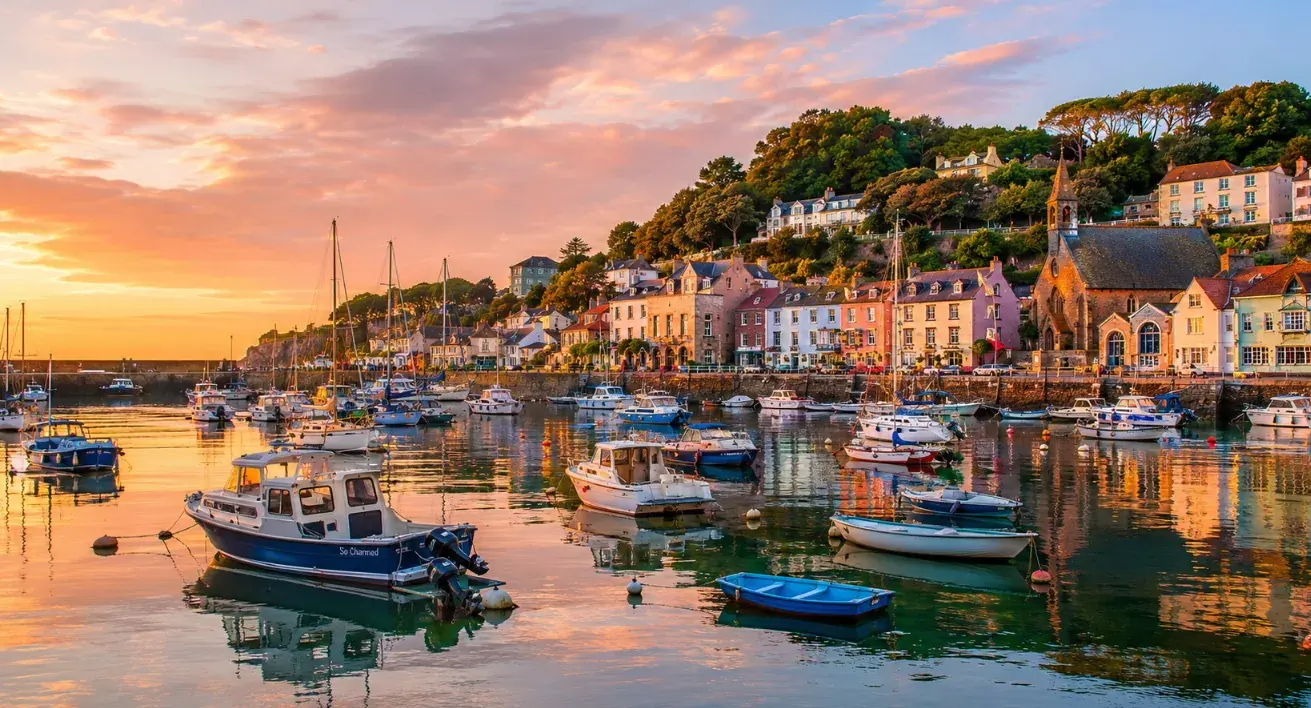
St Aubin's harbour at sunset
The Jersey Field Guide

Everything boring, sorted.

A long-form, local-written field guide to visiting Jersey — transport, tides, ETAs, weather, wildlife, festivals and the small habits that make a trip go smoothly.

Jersey at a glance

The island in eight facts

Size
119 km²
9 miles by 5 — you can cross it in 25 minutes
Population
~103,000
A third live in and around St Helier
Parishes
12
All named after saints, each with its own crest
Currency
Jersey £ (JEP)
Pegged 1:1 to GBP; UK notes accepted
Language
English
Plus French place names and native Jèrriais
Sunshine
1,900+ hrs/yr
Usually the sunniest spot in the British Isles
Tidal range
Up to 12 m
Among the largest tides in the world
Time zone
GMT / BST
Same clock as London, year-round
Arrivals 3 min read
Chapter 01

Getting to Jersey by air

Jersey Airport (JER) sits a short hop west of St Helier and is the easiest gateway to the island — a single small terminal that you can clear in minutes if you're not unlucky with peak crowds.

Direct flights run year-round from most UK regional airports — Gatwick, Heathrow, Manchester, Edinburgh, Birmingham, Bristol, Southampton and East Midlands all serve Jersey, with British Airways, easyJet, Jet2, Loganair and Blue Islands sharing the routes. In summer the schedule explodes: add Geneva, Zurich, Vienna, Innsbruck, Düsseldorf, Berlin, Madrid, Faro and others, plus seasonal charters.

Because Jersey is small, an airport delay can cost you a sizeable chunk of your trip. Land late on a winter Sunday and you'll find that taxi queues empty quickly. Book in advance or pre-arrange a transfer if you're arriving after 21:00.

Hand luggage and security rules are set by Jersey, not the UK — the 100 ml liquids rule still applies at the time of writing and the new CT scanners are being rolled out gradually. Don't assume what worked at Gatwick will work at JER.

Quick facts
  • Allow extra time in peak season — security queues can be long.
  • LibertyBus routes 15 and 22 connect the airport to St Helier in around 20 minutes.
  • Taxis are metered; expect £15–£20 to central St Helier.
  • Car hire desks are right at arrivals — book ahead in July and August.

Local tip · Sit on the left of the aircraft on UK approaches for the dramatic flyover of St Aubin's Bay and Elizabeth Castle.

Arrivals 3 min read
Chapter 02

Getting to Jersey by ferry

Ferries land you right in the middle of St Helier — step off the boat and you're already in the capital, no shuttle bus required.

Condor Ferries runs the main routes into the Elizabeth Terminal: fast catamarans from Poole and Portsmouth (around 3–4½ hours) and a conventional sailing from Portsmouth (10–11 hours overnight). From France, Manche Îles Express and Condor sail from St Malo in about 90 minutes, opening up Brittany and Normandy as easy day trips on either end of your stay.

Bringing a car saves you nothing on a short trip — Jersey is small, parking is metered, and rental cars are everywhere. Bring one if you're staying two weeks or have heavy gear, otherwise foot-passenger fares are far cheaper.

Crossings can be cancelled or merged in bad weather, especially in winter. Always have a flexible backup plan and travel insurance that covers missed connections.

Quick facts
  • Bring a passport for French sailings — ID cards aren't always accepted.
  • Foot-passenger and car options are both available; book ahead in summer.
  • The Elizabeth Terminal is a 15-minute walk from the town centre.
  • Check Ports of Jersey live updates the morning of departure.

Local tip · On a calm day the fast ferry from St Malo is genuinely scenic — keep an eye out for the Minquiers reef and dolphins.

Transport 4 min read
Chapter 03

Getting around by bus

LibertyBus is small-island public transport at its best: clean, modern, low-floor buses that go almost everywhere, run by a friendly team who'll happily tell you where to get off.

Every route radiates from Liberation Station in St Helier, right by the harbour. The 1 and 1A run east toward Gorey and Mont Orgueil, the 8 climbs the north coast to Bonne Nuit and Bouley Bay, the 9 swings round to Grève de Lecq, and the 12 and 22 head west to Corbière, St Ouen and the surf coast. Routes 14 and 15 cover the airport, hospital and Jersey Zoo.

Single fares are paid contactless on board — flat fee, no zones, no fuss. If you'll do more than three rides in a day, get an AvanchiCard: one day, three days or seven days of unlimited travel for less than the cost of a few singles. Buy them at Liberation Station or in the LibertyBus app.

Frequencies drop on Sundays, public holidays and in winter, so always check the live timetable before planning a one-bus-a-day mission to a remote bay.

Quick facts
  • AvanchiCards: 1-day, 3-day, 7-day — best value for visitors.
  • Pay contactless on board for single fares — no cash needed.
  • Buses are step-free, with wheelchair and pushchair space.
  • Last buses leave St Helier around 22:30 on most routes — earlier on Sundays.
Track your Bus Live

Local tip · Download the LibertyBus app for live arrivals and route maps — it's genuinely one of the best transport apps in the British Isles.

Transport 4 min read
Chapter 04

Driving in Jersey

Jersey driving rewards patience over speed. The island speed limit is 40 mph and the lanes were laid out for horses — slow down, breathe out, enjoy the granite walls and the sudden sea views.

Outside the main coast roads, you'll spend most of your time on single-track lanes lined with hedges, blind bends and the occasional cow. Drive on the left, keep your speed gentle, and use the passing places. If two cars meet, the one nearest a passing place reverses — there is no shame in it.

Look out for the Green Lanes network — quiet country roads with a 15 mph limit where walkers, cyclists and horse-riders have priority. They're brilliant for slow exploring and connect many of the prettiest valleys. Yellow lines on the road and a black border on the sign indicate a Green Lane.

Parking in St Helier uses pay-cards (paper) and the PayByPhone app. Buy paper pay-cards at petrol stations, post offices and many corner shops before you need them. On-street and multi-storey parking is colour-coded by maximum stay — read the signs or you'll get a yellow ticket.

Quick facts
  • Speed limits: 40 mph max, 30 in villages, 20 in residential areas, 15 on Green Lanes.
  • UK and EU/EEA licences are accepted — check rules for other countries.
  • Filter in turn at yellow box junctions — locals will not be impressed if you don't.
  • Petrol stations are scarce after 20:00 — fill up earlier on long days.

Local tip · If your sat-nav sends you down what looks like a footpath, trust it — Jersey lanes are narrower than the map suggests.

Before you go 5 min read
Chapter 05

ETA and travel documents

Jersey is a Crown Dependency, not part of the UK. Same king, separate immigration rules — which catches a lot of visitors out.

Most non-visa nationals (US, Canada, Australia, Japan, Singapore, Gulf states etc.) now need a UK Electronic Travel Authorisation (ETA) to enter Jersey, even though Jersey runs its own border. EU and EEA nationals also need an ETA. It's £16, applied for online or in the UK ETA app, and lasts two years.

British and Irish citizens do not need an ETA. Most other visa-holders (including Schengen short-stay visa holders coming from France) still need a separate Jersey-specific visa — the UK visa alone is not always enough. The Government of Jersey website has a clear visa checker; use it.

Bring a valid passport with at least the validity your airline requires (usually 3–6 months). EU national ID cards are no longer accepted for arrivals from most countries. EHIC and GHIC are not valid here, so travel insurance is essential — UK NHS reciprocal cover doesn't extend to Jersey for visitors.

Quick facts
  • Apply for the UK ETA before you fly — it normally comes through in minutes but allow 3 working days.
  • Carry your passport on day trips to France — you'll be in another country in 90 minutes.
  • Bring travel insurance with medical cover; GHIC is not accepted.
  • Customs allowances are different from the UK — check before bringing duty-free.

Local tip · Print or screenshot your ETA confirmation before you fly — patchy signal at the airport can make checking your inbox stressful.

Coast 4 min read
Chapter 06

Beach safety

Jersey beaches are beautiful and broadly safe — but the Atlantic doesn't care that you're on holiday. A few minutes of preparation goes a long way.

RNLI lifeguards patrol the most popular beaches between May and September — St Brelade's Bay, Plémont, Le Braye and Le Port at St Ouen, Grève de Lecq and Royal Bay of Grouville. They put up red-and-yellow flags marking the supervised swim zone. Swim inside that zone. Outside the season or the flagged area you're on your own, and the west coast in particular can develop strong rip currents in minutes.

Inflatables and bodyboards on the west coast are a routine cause of rescues — the offshore wind looks gentle from the dunes and is anything but. If you get pulled out, don't try to swim against the rip: float, raise an arm, and wait. Lifeguards on Jersey beaches are exceptional and reach you fast.

Cliff paths and rockpools are their own category of risk. Slippery seaweed, sudden drops and rising tides catch people out every summer. Wear proper shoes and don't take big tide bets.

Quick facts
  • Swim between the red-and-yellow flags only.
  • Red flag = do not enter the water. Black-and-white chequered = surfboard zone.
  • Watch for rip currents at St Ouen, especially around low tide.
  • Cliff-path edges can be unstable — keep dogs on a lead and stay on the path.

Local tip · Save the Jersey Coastguard number — 01534 447705 — in your phone before you set out on any coastal walk.

Coast 5 min read
Chapter 07

Tides and causeways

Jersey has one of the largest tidal ranges in the world — up to 12 metres. At low water the island almost doubles in size. At high water, paths you walked an hour ago are under deep, fast-moving sea.

Spring tides arrive twice a month, around the new and full moons, and bring the most dramatic difference between high and low water. On a big spring tide you can walk almost half a mile out from Le Hocq or La Rocque, across reefs and rock pools you'd never normally see. It feels otherworldly — but it's also when the sea returns fastest.

The two causeway walks that visitors most often want to do are Elizabeth Castle (out from St Helier across the bay) and La Corbière (out to the lighthouse). Both have published safe windows — usually 2–3 hours either side of low water — and both have signed warnings. Take them seriously. Locals get cut off every summer.

If you want to experience Jersey's seabed safely, book a guided low-tide walk. Jersey Walk Adventures and others run trips to Seymour Tower and the Écréhous reef — strange, beautiful walks across what is normally sea floor.

Quick facts
  • Always check tide tables (gov.je or any Jersey tide app) before coast or causeway walks.
  • Never attempt to walk to Elizabeth Castle or La Corbière as the tide rises.
  • Guided seabed walks are the safe way to explore the Royal Bay of Grouville and the reefs.
  • Sea fog can roll in fast — turn back early if visibility drops.

Local tip · A 'tidal coefficient' above 95 means a properly big tide — perfect for rockpooling and dramatic photos, perfect for getting cut off.

Safety 3 min read
Chapter 08

Emergencies & health

Dial 999 for police, fire, ambulance or coastguard — the same number as the UK. The hospital is in central St Helier and Jersey has excellent (if expensive without insurance) private healthcare.

Jersey General Hospital on Gloucester Street handles A&E. Walk-in care for minor injuries is at Le Bas Centre. Out-of-hours GP services are coordinated through the Jersey Doctors on Call line — your hotel or accommodation can guide you.

Pharmacies (chemists) run a rota for out-of-hours and Sunday cover. Big chains include Boots, but you'll find independents in every parish. Bring repeat prescriptions and a copy of your prescription from home — getting one filled is not automatic.

Travel insurance is essential. The UK GHIC is not valid in Jersey, and a single A&E visit without insurance can land a four-figure bill. Most card insurance and annual travel policies cover the Channel Islands, but always read the small print.

Quick facts
  • 999 — all emergency services (police, fire, ambulance, coastguard).
  • Non-emergency police: 612612.
  • Jersey Coastguard: 01534 447705.
  • Travel insurance is strongly recommended; GHIC is not accepted.

Local tip · If you're stung by a weever fish on St Ouen's Bay (it happens), very hot — not boiling — water for 30 minutes is the standard remedy.

Plan ahead 3 min read
Chapter 09

Accessibility on Jersey

Jersey is steadily getting better at access — flat promenades, low-floor buses, beach matting and accessible chairs at the main beaches — but it's an old island with hills, cobbles and historic sites that come with limits.

St Helier itself is largely flat and walkable, and the seafront promenades at West Park, Havre des Pas and St Aubin's are some of the most accessible coastal walks in the British Isles. LibertyBus is fully step-free with dedicated wheelchair spaces.

Several beaches lend out beach wheelchairs free of charge in summer — St Brelade's Bay, St Ouen and Plémont are among them. Book in advance through the Bea active charity (formerly Enable Jersey). Beach mats are laid down for easier crossing to the sand.

Older Jersey Heritage sites have real limitations: Mont Orgueil's castle is built on a rock with many steps, La Hougue Bie's Neolithic passage is low and narrow, and clifftop forts often have no lift. Check the access notes on each site's page before going.

Quick facts
  • Beach wheelchairs available free at several beaches — book ahead.
  • LibertyBus is step-free with audio and visual stop announcements.
  • Most major hotels have accessible rooms; some boutique inns do not.
  • Blue Badge holders can park free at most public car parks.

Local tip · Email the venue a few days ahead — Jersey is small, and staff often go out of their way to help with specific access needs.

Spending 3 min read
Chapter 10

Money, payments & GST

Jersey uses its own pound (JEP), pegged 1:1 to sterling. UK notes and coins are accepted everywhere; Jersey notes can be a souvenir when you get home.

Card and contactless are accepted almost everywhere — buses, taxis, kiosks, even the smallest beach café. You can spend a week without touching cash. ATMs are widespread in St Helier and at the airport; rural villages have fewer, so top up before a long coast day.

There is no VAT in Jersey. Instead, a 5% Goods & Services Tax (GST) is included in displayed prices. Tax-free shopping for visitors is limited — most tourist shops do not run schemes. Petrol and tobacco are cheaper than the UK; spirits and wine often noticeably so.

Tipping is appreciated but never expected. 10% in restaurants if service isn't included is generous; rounding up taxi fares is standard. Service charge is sometimes added automatically to bills for parties of six or more — check before adding again.

Quick facts
  • Card and contactless work almost everywhere, including on the bus.
  • GST is 5%, already included in displayed prices.
  • Spend or change Jersey banknotes before you leave — UK shops may refuse them.
  • ATMs are easy in town, scarce in the rural west and north.

Local tip · Keep a £20 Jersey note as a souvenir — they often feature the parish churches and the wildlife of the island.

Plan ahead 4 min read
Chapter 11

Weather & best time to visit

Jersey claims more sunshine hours than almost anywhere in the British Isles. The Atlantic keeps it changeable, the Gulf Stream keeps it mild, and the light is unusually clear.

Summer (June–September) is the peak. Long evenings, sea around 17–18 °C in August, busy harbour villages and packed beach cafés. Book accommodation early — Jersey has only so many rooms, and weekends fill out months in advance. School holiday weeks in July and August are the most expensive.

Shoulder seasons (May and October) are the local secret: wildflowers, warm light, lighter crowds and most attractions still open. September often delivers the best swimming sea — warmer than July most years. Spring brings cliff paths thick with sea pinks and bluebells.

Winter is quieter and many seasonal beach cafés and some attractions close. But storm-watching at La Corbière, fish-and-chips on a rainy promenade, and Jersey War Tunnels on a moody afternoon are all underrated experiences. The climate is mild — frost is rare, snow rarer still.

Quick facts
  • June–September: warmest, busiest, longest opening hours.
  • May & October: quieter, mild, beautiful light for photos.
  • Winter: many attractions reduced; coast walks shine.
  • Average summer high ~21 °C; sea around 17–18 °C in August.

Local tip · Pack a thin waterproof and an extra layer year-round — Atlantic showers blow through quickly, but they do blow through.

Culture 3 min read
Chapter 12

Language & local know-how

English is the everyday language. French shows up on maps and street signs, and the ancient Norman language Jèrriais still echoes in parish names and the older generation's banter.

Every parish is named after a saint — St Helier, St Brelade, St Ouen, St Martin, St Saviour — and many lanes still carry their old French names. 'La Mielle' means sand dunes, 'Le Mont' is a hill, 'Les Vaux' is a wooded valley, and 'Le Câtel' is a hilltop fort. Once you know the keywords, the map starts telling stories.

Jèrriais (sometimes called Jersey French) is the indigenous Norman language of the island. Maybe a thousand speakers remain, mostly older — but you'll hear it at the Christmas markets, on bilingual road signs in the north and at Jèrriais conversation evenings in St Helier. It's not French and not English; it has its own words for the wind, the tide and the seasons.

Locals tend to say 'the island' rather than 'Jersey' in conversation. People say 'good night' instead of 'goodbye' at the end of a visit, even in the daytime. Don't call it 'New Jersey' or 'the Jersey' — it's just Jersey.

Quick facts
  • Parish names are French (St Helier, St Brelade, St Ouen…).
  • 'La Mielle' = sand dunes; 'Le Mont' = the hill.
  • Locals say 'the island' rather than 'Jersey'.
  • A few Jèrriais words still in daily use: bouonjour (hello), mèrcie (thanks).

Local tip · If a road sign carries a strange name, look it up — Jersey place names often describe the landscape with surprising precision.

Practical 2 min read
Chapter 13

SIM cards, roaming & wi-fi

Jersey is not in the UK or the EU, so your 'roam like at home' plan may suddenly start charging. Check before you fly, not after.

Three local networks — JT, Sure and Airtel — share strong 4G/5G coverage almost everywhere except a few wooded valleys. Many UK and EU SIMs work here but at extra cost. EE has a Channel Islands roaming add-on; O2, Vodafone and Three vary by plan. Read the small print or you'll come back to a surprise.

If you're staying more than a few days and want to use mobile data freely, a local PAYG SIM or eSIM is cheaper. JT and Sure shops in St Helier sell them at the airport and on King Street.

Free Wi-Fi is widely available — most hotels, every café worth its name, every LibertyBus and the public Wi-Fi network around St Helier marina all offer good speeds.

Quick facts
  • Many UK 'roam-like-at-home' plans exclude Jersey — read your plan.
  • Local PAYG SIMs sold at JT and Sure shops in St Helier.
  • Wi-Fi is reliable in cafés, hotels and on LibertyBus.
  • Coverage is strong nearly everywhere except a few wooded valleys.

Local tip · Download offline Google Maps for the whole island before you arrive — it's tiny and saves a roaming charge if your plan plays up.

Practical 1 min read
Chapter 14

Power, plugs & time

Jersey uses UK three-pin Type G plugs at 230 V / 50 Hz, and shares London's time zone — GMT in winter, BST in summer.

If you're flying in from the UK, your kit just works. From the EU or North America, bring a Type G adapter and check your appliance handles 230 V. Most modern chargers do; older hairdryers and shavers might not.

The clocks change with the UK in late March and late October. Jersey doesn't operate on continental time, despite being closer to France than to England.

Quick facts
  • Bring a UK Type G plug adapter if you're travelling from outside the UK.
  • Most hotels provide hairdryers and USB sockets in newer rooms.
  • Time zone: GMT in winter, BST in summer (same as London).

Local tip · USB-C is now common in hotels — leave the wall adapter at home if you've upgraded your devices recently.

Plan ahead 2 min read
Chapter 15

Opening hours & seasonality

Jersey runs on a softer rhythm in winter — many attractions close, kiosks board up, and even some restaurants take a long January break. Always check.

Spring to autumn (April–October) is when the island is fully open. Castles, beach kiosks, surf-coast cafés, boat trips, La Mare Wine Estate, the steam museum — almost everything runs daily or close to it. Outside that, expect reduced hours, weekend-only openings, or full winter closure.

Sundays remain quieter than weekdays. Bigger supermarkets and chains open, but many independent shops and family-run cafés take the day off. Restaurant booking is still essential at weekends in summer.

Quick facts
  • Always check opening times on the official website before travelling.
  • Last entry to castles and museums is usually 60–90 minutes before close.
  • Beach kiosks and surf-coast cafés are mostly April–October only.
  • Sundays are quieter — book restaurants ahead if you want a specific place.

Local tip · If you're visiting in November–March, build a 'wet plan' for each day — Jersey War Tunnels, the Maritime Museum and a long pub lunch will save any forecast.

Culture 3 min read
Chapter 16

Festivals & seasonal events

For a 119 km² island, Jersey punches absurdly above its weight on festivals. Time your visit right and the island feels like one rolling event.

Spring brings the Genuine Jersey events and the Jersey Walking Festival (May), which leads you across cliffs, beaches and seabed with guides who've walked them their whole lives. June bursts open with the Jersey Live & Weekender music festivals on weekends, and the air shows over St Aubin's Bay.

The summer flagship is the Battle of Flowers in August — the island's biggest day out, a 120-year-old parade of giant flower-decorated floats down Victoria Avenue. Tickets sell out months ahead. Branchage Film Festival (September) screens international shorts in unusual outdoor venues.

Autumn slows down with food festivals — Tennerfest (October–November) sees most restaurants run multi-course menus from around £15–£25, a brilliant time to try the high-end places. December's Christmas markets, lights on King Street and parish carol services close out the year.

Quick facts
  • Battle of Flowers (August) — book accommodation many months ahead.
  • Tennerfest (October–November) — affordable tasting at almost every restaurant.
  • Jersey Walking Festival (May) — guided coast and seabed walks.
  • Branchage Film Festival (September) — open-air screenings in heritage venues.

Local tip · Visit Jersey's events calendar a couple of months out — even smaller parish fêtes are worth detouring for if you happen to be there.

Outdoors 3 min read
Chapter 17

Wildlife & nature

Jersey is small enough that you can walk between three completely different ecosystems in an afternoon — north-coast cliffs, west-coast dunes, south-coast reefs.

Birdwatchers love the spring and autumn migrations along the north coast. Look out for Dartford warblers in the gorse, peregrines diving along the cliffs and choughs (recently reintroduced) at Plémont and Sorel. Bottlenose dolphins are seen regularly off the south and east coasts, especially in summer — boat trips from Bouley Bay and Gorey occasionally meet them.

Spring on the cliff paths is extraordinary: sea pinks (thrift), bluebells, primroses and orchids in places. The Jersey Coastal National Park covers most of the protected coastline; stay on the paths to protect rare plants and ground-nesting birds.

Closer to the ground, low tide reveals one of the best rockpooling shores in Europe. Shore crabs, anemones, blennies, gobies, sea slugs and the occasional small octopus turn up in pools at La Rocque and St Catherine's. Touch lightly, return everything where you found it.

Quick facts
  • Peregrines and choughs along the north coast cliffs.
  • Bottlenose dolphins seen regularly in summer — boat trips from Bouley Bay and Gorey.
  • Spring wildflowers on the cliff paths — stay on the path.
  • Rockpooling is excellent at La Rocque and St Catherine's at low tide.

Local tip · Pack binoculars if you're a birder — Jersey is a serious migration stopover and the cliff paths give you 100-mile views on clear days.

Plan ahead 2 min read
Chapter 18

Travelling with dogs

Jersey is unusually dog-friendly. Pubs welcome them, ferries take them, and most cliff paths and beaches are happy to share — within the seasonal rules.

Dogs travel free on Condor Ferries in pet-friendly cabins or on-deck areas; flights from the UK are more restricted. Bring up-to-date vaccinations and microchip records. Jersey is rabies-free and takes biosecurity seriously.

Beach rules vary by season. Most beaches ban dogs from the central section between May and September during the day, but allow them before 10:30 and after 18:00. Off-season, dogs are usually welcome anywhere on the sand. Always check the signs at the entrance.

Cliff paths and Green Lanes are some of the best dog walks in the British Isles — gorse, granite and miles of safe trails. Many country pubs (and a surprising number of harbour cafés) have water bowls out and welcome dogs inside.

Quick facts
  • Most beaches: dogs allowed before 10:30 and after 18:00 in summer.
  • Off-season (Oct–Apr): dogs usually welcome on most beaches all day.
  • Many pubs and country cafés welcome dogs inside — check first.
  • Pick up after your dog — fines are real and locally taken seriously.

Local tip · Pack a quick-drying dog towel — Jersey beaches mean wet dogs, all year round.

Outdoors 3 min read
Chapter 19

Photography & where the light is

Jersey's coast points in every direction, so wherever the sun is, somewhere on the island has perfect light. A little planning turns a holiday into a portfolio.

Sunrise is at its best on the east coast — Mont Orgueil from Gorey harbour, the seabed at La Rocque, the lighthouse on Icho Tower from the seafront. Sunset belongs to the west: La Corbière is the obvious icon, but Plémont and El Tico on the surf coast are quieter and just as good.

Blue hour around La Corbière, with the lighthouse just lit and the tide rising, is one of the best 30 minutes of light in the British Isles. Get there early, set up high, and stay until the colour drains out of the sky.

Low tide opens up shots that no one in your feed will have. The reefs at La Rocque, the long sand at St Ouen, the rock formations at Plémont — all completely transformed twice a day. Check the tide tables before the day, not when you arrive.

Quick facts
  • Sunrise: Mont Orgueil from Gorey, La Rocque seabed, St Catherine's breakwater.
  • Sunset: La Corbière, El Tico, Grosnez ruined castle on the cliffs.
  • Blue hour at La Corbière is legendary — stay 30 minutes past sunset.
  • Low tide unlocks reefs and patterns you won't see at high water.

Local tip · A small tripod or beanbag goes a long way — sunset on a granite wall is rarely a hand-held shot.

Culture 2 min read
Chapter 20

Visit lightly

Jersey is small. Every tide, every cliff path, every harbour café feels the footfall. A handful of habits keep the island the way you came to see it.

Take the bus or walk where you can — emissions are part of it, but small lanes also clog quickly. Buy from independent producers when you can: Genuine Jersey marks farm-shop produce, dairy, gin, cider and crafts that keep money on the island.

Respect coastal wildlife and habitats. Don't move boulders in rockpools (you're destroying decades-old ecosystems). Stay on cliff paths in nesting season. Take rubbish home — beach bins fill fast in summer, and what spills out ends up at sea.

Carry a reusable cup and bottle — Jersey tap water is excellent and many cafés will refill for free. Decline the single-use option whenever you can.

Quick facts
  • Use LibertyBus, walk and cycle — and rent a car only when you need it.
  • Buy Genuine Jersey-marked produce and crafts.
  • Leave rockpools the way you found them.
  • Tap water is excellent — bring a refillable bottle.

Local tip · Most beach cafés are happy to refill a water bottle for free — it never hurts to ask.

Culture 2 min read
Chapter 21

Reading & listening before you go

A handful of books, films and podcasts turn a Jersey trip from sightseeing into understanding. None of them are long.

Read 'The Guernsey Literary and Potato Peel Pie Society' for the Channel Islands Occupation in fiction; 'Jersey Occupied' for the same period in history. For nature, John Le Sueur's older volumes still read brilliantly. For something contemporary, the BBC's 'Islands of the Channel' radio episodes are short, sharp and free.

Watch the 2018 film of the Potato Peel Pie Society — much of it was shot on Jersey doubling for Guernsey, and you'll recognise corners on every coast walk. The 'Bergerac' reruns on UKTV give a perfect 1980s Jersey time capsule, if you're into that.

Podcast-wise, 'Bailiwick Express Daily' is the local five-minute news catch-up. 'The Jersey Pod' runs longer-form interviews with islanders that give you a feel for the small-place politics and the quiet pride.

Quick facts
  • Read: 'The Guernsey Literary and Potato Peel Pie Society' (fiction).
  • Read: 'Jersey Occupied' (history) for the WWII story.
  • Watch: the 2018 Potato Peel Pie film — half of it is filmed here.
  • Listen: 'Bailiwick Express Daily' for a local five-minute briefing.

Local tip · Pick one of each before you fly — your first walk along Havre des Pas will hit completely differently with the soundtrack in your head.

FAQ

Questions fréquentes

Les questions que les visiteurs nous posent le plus — avec des réponses honnêtes d'un habitant, sans vernis d'office de tourisme.

  • En avion, Jersey est à un peu moins d'une heure de Londres, avec des vols directs depuis plus de 25 aéroports britanniques et européens. Par la mer, les ferries Condor partent de Poole et Portsmouth au Royaume-Uni, ainsi que de Saint-Malo en France — la traversée française dure à peine 90 minutes, ce qui permet aussi d'ajouter facilement une excursion en Normandie ou en Bretagne à un séjour à Jersey.

  • Jersey applique ses propres règles d'entrée et ne fait pas partie du Royaume-Uni. De nombreux visiteurs qui n'avaient auparavant besoin d'aucun document doivent désormais obtenir une ETA (autorisation électronique de voyage). Les règles évoluent : consultez le site du gouvernement de Jersey bien avant votre départ.

  • L'île est petite. LibertyBus dessert la plupart des plages et des villages au départ de la Liberation Station de St-Hélier, avec des cartes Avanchi à la journée ou sur plusieurs jours pour voyager sans limite. St-Hélier, St-Aubin et les villages portuaires se parcourent facilement à pied, et beaucoup de visiteurs combinent le bus avec une seule journée de location de voiture.

  • Pas nécessairement. Le bus, la marche et un taxi de temps à autre couvrent l'essentiel de l'île, surtout en été. La voiture est utile pour enchaîner les arrêts sur la côte nord, rejoindre des baies isolées ou visiter plusieurs lieux dans la même journée. Les routes sont étroites et les vitesses limitées — conduisez tout en douceur.

  • La baie de St-Brelade est la favorite polyvalente : eau turquoise, sable, cafés et abri du vent. La baie de St-Ouen offre 5 miles de côte spectaculaire dédiée au surf. Pour une journée en famille au calme, essayez Grève de Lecq sur la côte nord ; pour les photos, filez à Plémont Bay à marée basse ou à la Royal Bay of Grouville.

  • Le Jersey Museum, le Maritime Museum, les Jersey War Tunnels et l'Occupation Tapestry Gallery sont d'excellents choix par temps de pluie. Ajoutez un long déjeuner dans l'un des restaurants du port et la journée est réussie. Consultez notre catégorie « Idées pour jours de pluie » pour d'autres suggestions.

  • Oui — Jersey est une excellente destination familiale. Le Jersey Zoo, les mares de rochers de Grève de Lecq, la quête au château de Mont Orgueil, les balades tranquilles dans le parc national et les glaces en bord de mer à Havre des Pas fonctionnent très bien avec des enfants. Les trajets sont courts : pas de longues heures de voiture.

  • La vie nocturne de St-Hélier se concentre autour de la marina et de la Royal Square. The Drift, au Royal Yacht, est parfait pour les cocktails ; le Blue Note Bar pour la musique live ; Chambers pour un pub local animé ; et les restaurants du front de port pour une soirée plus tranquille. Vérifiez le programme avant de sortir — les établissements changent.

  • Les pommes de terre nouvelles Jersey Royals (protégées comme le champagne), les huîtres et les moules élevées dans la Royal Bay of Grouville, le homard et le crabe frais, et des produits laitiers d'une richesse incomparable — la glace locale est un incontournable des vacances. Cherchez aussi le black butter (lé nièr beurre), une confiture de pommes épicée vieille de plusieurs siècles, encore préparée lors des « black butter nights » collectives d'automne.

  • De mai à septembre, le temps est le plus doux et les journées les plus longues — et Jersey enregistre plus d'heures de soleil que n'importe où ailleurs dans les îles Britanniques. Juin offre les plus longues soirées, septembre une mer chaude et moins de monde, et le printemps couvre les sentiers de falaise de fleurs sauvages. L'hiver a aussi ses adeptes : observer les tempêtes à Corbière est spectaculaire.

  • Jersey connaît l'un des plus grands marnages du monde — jusqu'à environ 12 mètres, au point que l'île double presque de superficie à marée basse. La marée détermine où l'on peut marcher, nager et explorer. Vérifiez toujours les horaires pour des sites comme le château Élisabeth, le phare de La Corbière, les grottes de Plémont et toute marche sur l'estran : la mer remonte très vite.

Une remarque sur l'exactitude des informations. Ce guide est conçu pour vous aider à préparer votre voyage. Les horaires d'ouverture, les tarifs, les règles d'entrée, les transports et les informations de marée peuvent changer. Vérifiez toujours les sources officielles avant de partir ou de réserver.
Planificateur de voyage

Laissez notre IA tout organiser pour vous

Indiquez-nous votre nombre de jours, votre style de voyage et vos moyens de transport — nous nous occupons du reste.

Ouvrir le planificateur